


There are exactly two things in the United States that Congress has struck from the legal definition of a ‘commodity’.
The first is onions. In 1955 two traders, Vincent Kosuga and Sam Siegel, cornered roughly 98% of the onions in Chicago, squeezed the growers, then flooded the market and bankrupted a good number of them. Not very nice. Congress responded with the Onion Futures Act, sponsored by a young Michigan congressman named Gerald Ford and signed by Eisenhower in 1958. The president of the Chicago Mercantile Exchange, watching a fifth of his trading volume disappear, described it as burning the barn down to catch a rat. The ban still stands - cry if you will as you chop them.
The second thing is the money your local cinema takes on a Friday night.
Both prohibitions live in the same short piece of statute, 7 U.S.C. § 13-1, because in 2010 Hollywood asked to be added to the onion law. That is not a metaphor. Motion picture box office receipts were written into the Onion Futures Act as an amendment, at the industry’s own request, and they have sat there ever since alongside the root vegetable.
I have been writing about this business for over twenty-five years and even I had forgotten it - until I started researching this piece. Which is awkward, because as of this summer the BO markets are back, they are trading in dollars, and nobody in exhibition seems to have noticed.
The market that lasted two days
The idea was never that exotic. The Hollywood Stock Exchange had been running since 1996 as a play-money game in which users traded “MovieStocks” priced against a film’s first four weeks of wide release. Cantor Fitzgerald bought it in 2001, correctly identifying that a crowd of obsessives generating free forecasting data might be worth something to the people who make the films.
By the late 2000s, with independent financing evaporating in the credit crisis, Cantor and a rival called the Trend Exchange proposed the logical next step: real-money contracts on domestic box office receipts, so that a distributor could hedge a slate, the same way an airline hedges fuel. The CFTC approved both, finding by a three-to-two vote that box office receipts met the statutory definition of a commodity, that the contracts were not readily susceptible to manipulation, and that they offered a genuine means of managing risk.
The industry’s response was immediate and, in lobbying terms, magnificent. The MPAA, the major studios and (importantly for readers of this Substack) the National Association of Theatre Owners (now Cinemas United) all opposed it, arguing the contracts were open to insider trading and that a rival studio could quietly short your film. Senator Blanche Lincoln of Arkansas inserted a provision into Dodd-Frank excluding from the definition of a commodity “motion picture box office receipts, or any index, measure, value or data related to such receipts.”
The House passed it two days after Cantor’s approval came through. The amendment was made retroactive by thirty days, voiding the approvals. Years of work and millions of dollars produced a market with a lifespan of forty-eight hours. Barney Frank, one half of the act’s name, later admitted he had forgotten the provision was in there at all.
Two details are worth holding on to. The first is that Congress did not ban prediction markets, or event contracts, or even entertainment wagering. It banned one underlying asset. The second is that the stated objection (manipulation) sat rather awkwardly next to the unstated one, which was that studios did not want an external, public, real-time price on a film before they had finished telling everyone how it was going to do.

The ban that didn’t hold
Now open Polymarket.
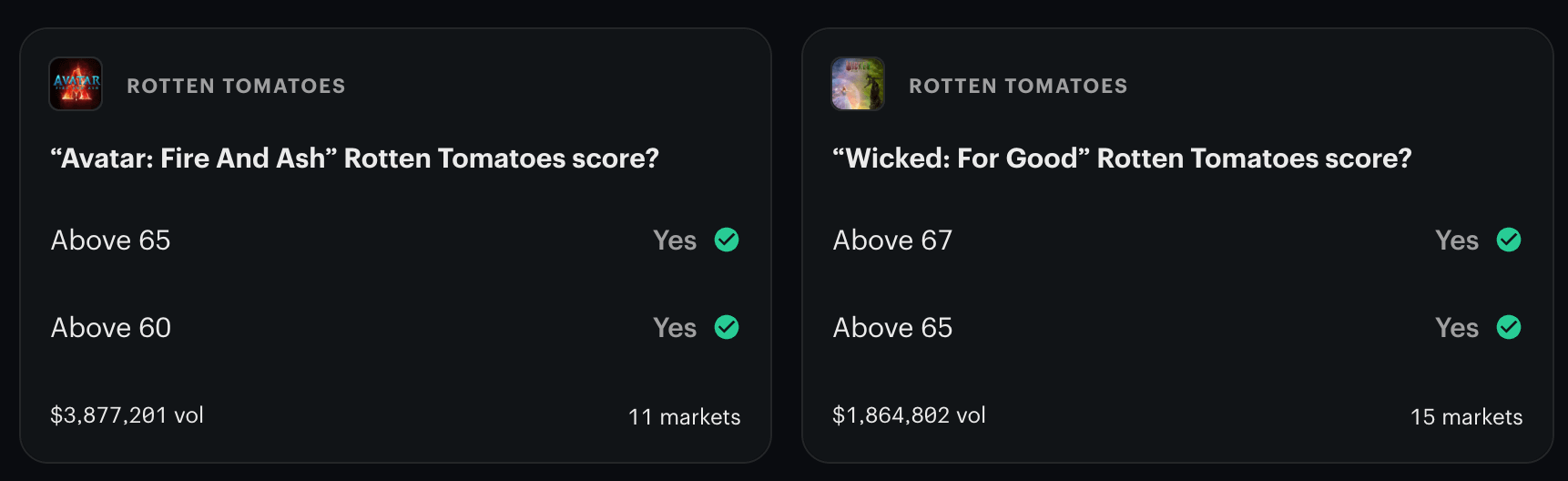
As I write, there are live, dollar-denominated markets on the domestic second weekend of Christopher Nolan’s The Odyssey, with roughly $1.4 million traded on the main market on its opening weekend and a second book on the higher strikes. There have been comparable markets this year on Scary Movie, on Nate Bargatze’s The Breadwinner, on Minions & Monsters, and a running market on the highest-grossing film of 2026. Kalshi has approached it from a different angle, launching Rotten Tomatoes score markets in March 2025 that resolve on the Monday after wide release and have become among the most heavily traded on the platform.
Read the statutory language again. “Any index, measure, value or data related to such receipts.” It is difficult to construct a reading in which a contract resolving on a film’s domestic opening weekend gross is not a contract on box office receipts.
I am not a lawyer and I am not going to pretend the position is settled. Polymarket now operates in the US through a CFTC-designated entity acquired for the purpose, the venues are structured as event contracts rather than futures, and there is a long-standing argument that instruments sold only to sophisticated counterparties sit outside the Commission’s remit entirely. But the plain fact is that the thing Hollywood spent a fortune extinguishing in 2010 is now trading in six-figure and seven-figure volumes, and neither the studios nor the exhibitor trade bodies have said a word. Why?
Partly that is because everyone is distracted. Prediction markets are currently fighting for their lives on a different front: Minnesota has criminalised operating one, a New York federal judge has ruled that state gambling law is not preempted by the Commodity Exchange Act, Massachusetts and Nevada have issued injunctions, and the circuit split is heading towards the Supreme Court. Against a fight over sports contracts worth $31 billion in a single month, a market on the second weekend of a Wayans brothers revival is a rounding error.
But it is our rounding error, and it is worth asking what it is actually good for.
Are the crowds better than the trackers?
Short answer: no, and I think the evidence is clearer than the prediction market enthusiasts would like.
The seductive claim is that a market aggregates dispersed private information into a single price, so it ought to beat any individual forecaster. The problem with applying that to box office is that the dispersed private information mostly doesn’t exist. There is no crowd of onion farmers here, each holding a piece of the truth. There is one distributor who knows the tracking, a handful of circuit that knows their pre-sales at scale, and several thousand traders who know what they read on a forum.
You can see this in the markets themselves, which is the part I find genuinely funny. Polymarket’s own market pages describe positions forming around tracking published by BoxOffice Pro and BoxOffice Theory. The market is not discovering a price. It is reading Comscore’s (now Rentrak’s) homework and marking it up.
The academic record supports the same conclusion. HSX has an excellent reputation for accuracy, but when researchers at HP Labs tested a crude model built only on the rate of tweets about a film, it beat HSX on opening weekend, 97.3% against 96.5%. If a Twitter/X firehose with no financial incentive attached can outperform the gold-standard prediction market, the market’s edge is not information aggregation. It is that both are downstream of the same publicly visible buzz.
Worse, the biases run in the wrong direction for our purposes. Comparative work on market and non-market forecasting found that both mechanisms over-predict small films and under-predict large ones. That is precisely backwards. Nobody in exhibition needs help forecasting the middle of the distribution; the tracking does that adequately and has done for decades. What costs the industry money is the tail: the Barbenheimer, the Minecraft Movie, the Sinners, the title that triples its tracking and finds every circuit short of screens and staff on the Saturday. Markets are no better at those than the professionals, for the simple reason that the information that would have predicted them did not exist in advance.
And then there is liquidity. Roughly 87% of Kalshi’s trailing volume comes from sports contracts. Individual film markets trade in the tens or low hundreds of thousands. A market that thin is noise with a decimal point, and every film is a sample of one: no repeat fixtures, no back-tested base rates, a new product with a new cast in a new competitive frame every fortnight.
The trackers win. Not because they are brilliant, so much as because the market is drinking from the same well and paying a transaction cost for the privilege.
Manipulation: three arguments, one of which is serious
The 2010 objections deserve to be separated, because they are not of equal weight.
Insider trading is the one everyone reaches for first and it is the most tractable. Studios see their tracking; circuits see pre-sales by hour and screen. This is a genuine asymmetry, but it is the ordinary condition of every commodity market ever built, and there is now enforcement machinery: in April 2026 the CFTC brought its first insider trading complaint concerning event contracts, and Kalshi disciplined political candidates trading their own races. Solvable, in principle, with position limits and disclosure.
Cornering is the cheapest attack and the least discussed. You do not need a Kosuga-scale war chest to move a market with $60,000 of open interest. Shifting the implied opening weekend of a competitor’s film costs less than a single trailer placement. In 2010 this was hypothetical, but at current volumes it is trivially affordable. Worrying.
Reflexivity is the argument that actually matters, and it is the one unique to this asset class. A weather market does not change the weather. An election market has at least a plausible claim to neutrality. But a visible market price on a film’s opening weekend becomes a story, the story becomes the coverage, the coverage becomes the audience’s prior, and the audience’s prior becomes the gross. We already live with a mild version of this: the Wednesday tracking leak that hardens into a narrative of “underperformance” before a single ticket has been torn. A public, continuously updating flop price industrialises that process.
Hollywood’s 2010 objection was self-interested and it was also, I think, correct. That is an uncomfortable combination and worth saying plainly.

Everyone is asking the wrong question
Here is where I think the debate has been mis-framed for sixteen years, including by the people who tried to build these exchanges.
Per-title markets are the wrong product. They duplicate tracking, they are thin, they are reflexive, and their principal beneficiary is a trader in Ohio with a view on Nolan. They offer exhibition nothing it does not already buy.
The unmet need is not the film; it is the box office year as a whole.
Consider the risk an exhibitor actually carries. A circuit signs twenty-year leases, commits capital to recliners and laser projection and premium formats, and staffs to a forecast, all against a variable it does not control and cannot hedge: total admissions. An airline can hedge fuel. A baker can hedge wheat. A cinema operator facing a strike-delayed slate, a soft fourth quarter, or a summer where three tentpoles move at once has precisely no instrument available. None. The exposure is total and it is uninsurable.
A liquid contract on aggregate territory admissions or gross for a forward twelve months would be genuinely new. It would be useful for staffing and capex phasing. It would give lenders a market-implied view for covenant setting rather than a management projection. It would let a mid-size independent take the other side of a bad year rather than simply absorbing it. And it would be far harder to manipulate or to make reflexive than a single-title market, because no individual actor’s marketing spend or narrative moves a national annual total, and because the resolution source (Rentrak, Gower Street Analytics, Omdia, the national trade bodies) is already published and audited.
That contract does not exist anywhere in the world. It is also, awkwardly, exactly what the 2010 statute prohibits in the United States, since an index of aggregate box office receipts is about as squarely inside “any index, measure, value or data related to such receipts” as it is possible to get. The industry lobbied away the one version of this that would have helped it, in order to kill the version that wouldn’t.
What would actually get disrupted
Assume the aggregate market gets built. The casualties are more interesting than the obvious ones.
Tracking as a paid product. NRG and Rentrak (formerly Comscore) sell forecasts to a small number of buyers at prices that reflect scarcity. A public price is a levelling instrument, and its main beneficiaries are the people currently priced out: independents, smaller territories, single-site operators who today book on instinct because the data costs more than the screen earns.
The Wednesday scoop. A substantial part of the trade press economy is the privileged early number. That has considerably less value when a public price has already moved.
Opening weekend spin. Studio estimates on a Sunday morning are a managed communication. They are harder to manage against a market that has been pricing the answer since Thursday previews.
Film finance. Gap lenders, slate insurers and completion guarantors currently price off comparables and judgement. A forward curve on aggregate admissions changes the cost of capital for the whole sector, and probably not in the direction the optimists assume.
The exhibitor-distributor conversation. This is the one I would watch. Film rental terms are negotiated in a fog that suits whoever has better information, which is usually not the exhibitor. A public forward price is not a magic equaliser, but it does make some positions considerably harder to argue with a straight face.

A European coda
One last thing, and it is the reason I think this is worth the attention of readers on this side of the Atlantic.
The ban is American. Section 13-1 binds US exchanges. Nothing in EU or European countries laws removes box office receipts from the universe of tradeable underlyings, and the Trend Exchange said as much in 2010 when it threatened to list the contracts offshore, before losing interest.
Europe has the exchange infrastructure, it has an established culture of event markets, and through the national trade bodies and the pan-European statistical apparatus it has audited, published admissions data that would function perfectly well as a resolution source. If an aggregate European admissions contract is going to exist anywhere, it will not be listed in New York but in Amsterdam, Paris or Frankfurt, if not London.
Whether anyone in this industry actually wants it is a separate question, and the historical evidence is not encouraging. The last time somebody offered exhibition a mechanism for pricing its own risk, exhibition helped bury it inside a law about onions. Onions!
Not sure how helpful this is, but here goes.
1) Cantor Fitzgerald is owned by the family trusts of Howard Lutnick, US Commerce Secretary in the Trump II administration.
2) Donald Trump Jr., the US president’s eldest son, is both an investor in and an unpaid adviser to Polymarket, and a paid adviser to Kalshi.
Patrick, this was an amazing and interesting article on a subject that is totally out of control, as you likely know I predict boxoffice in my INDIDE THE FILM INDUSTRY EMAILS. I am “under the radar” as I have tracking data that is precise or at the least close to the actual numbers. I also have cultivated studio relations few know about.. I also have learned over the years how to write about forthcoming movies in a way that is inoffensive, yet understood.
In 1984, I began what became MOVIELINE INTERNATIONAL that I sold in 2010. At its peak, I had around 1500 domestic/international exhibition and distribution clients.
Today, after the last 20 years spent working on the restoration of the Kentucky Theatre in Lexington, KY and involved in independent distribution, I return to my first love writing about the movies.
At 81 (I know I act like I’m 12) this is likely my last contribution to the my five decade (and counting) industry only those of us know best. 🍿🎞️🍷